AI agents for personalised wealth management give every client the kind of attention that today only the largest relationships receive. They keep track of each client's goals, risk profile, holdings and life events, watch for changes that matter, prepare next-best actions and meeting briefs, and check every proposal against suitability rules before an adviser sees it. The adviser stays in charge of the advice and the relationship. The agent removes the research, preparation and paperwork that limit how many clients each adviser can serve well.
This guide is for heads of wealth, private banking and advisory businesses. It explains where agents add value, how to keep advice suitable and compliant, and how to start without disrupting client relationships.
Why is personalisation so hard in wealth management today?
Clients expect advice that reflects their whole situation, delivered when something changes. Advisers want to give it, but most of their week goes on preparing reviews, gathering data from several systems, writing up recommendations and documenting suitability. The result is a familiar trade-off: deep personalisation for a few top clients and standardised service for the rest.
Agents change that trade-off because preparation is repeatable work. When the preparation is done for every client, the adviser's time goes on the conversation and the judgement.
What does a wealth management agent do?
On ElixirClaw, wealth agents work across the CRM, portfolio system and market data, within limits set by the firm.
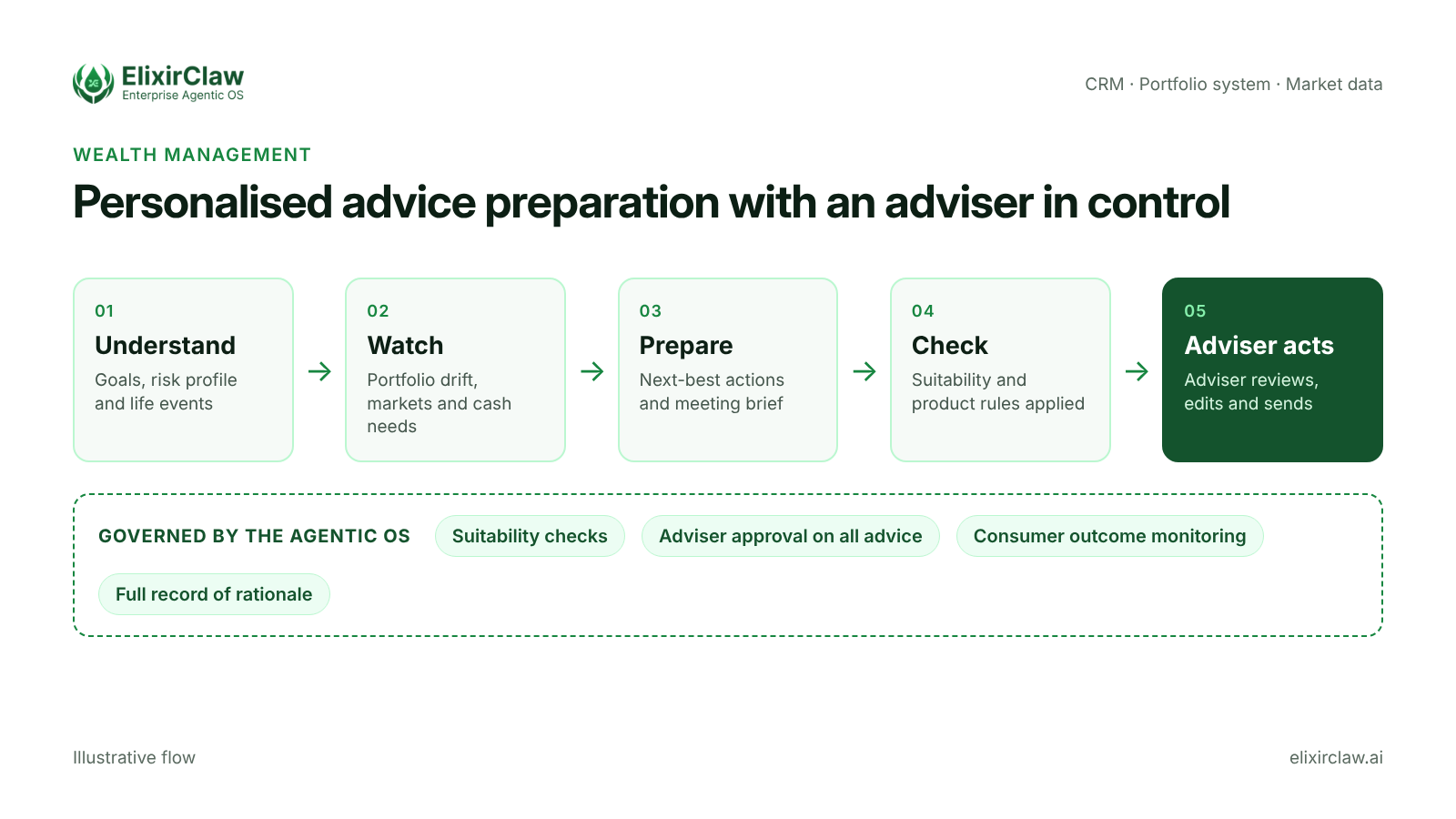
- Understand. The agent keeps a current picture of each client: goals, risk tolerance, constraints, preferences and recent life events from meeting notes and CRM.
- Watch. It monitors portfolio drift, concentration, cash needs, maturing products and market moves that affect the client.
- Prepare. It drafts next-best actions, a meeting brief and personalised commentary in the client's language and level of detail.
- Check. Suitability, product eligibility, concentration limits and disclosure requirements are checked before anything reaches the adviser.
- Adviser acts. The adviser reviews, edits and decides what to recommend and send. The rationale is recorded with the client file.
Where do agents create the most value?
| Use case | What changes for the client | What changes for the adviser |
|---|---|---|
| Proactive reviews | Contact when something actually changes, not only on the annual cycle | A prioritised list of clients who need attention, with reasons |
| Meeting preparation | Discussions start from their goals and recent events | A ready brief instead of an hour of preparation |
| Rebalancing and tax awareness | Portfolios kept closer to their agreed strategy | Proposals that already respect constraints and suitability |
| Life event support | Timely guidance on retirement, inheritance or a business sale | Triggers and draft plans when an event is detected |
| Personalised reporting | Commentary that explains what changed and why it matters to them | Reports drafted, checked and ready to send |
How do you keep personalised advice suitable and compliant?
Personalisation raises the stakes on suitability and fairness, so the controls belong in the workflow itself.
- Adviser approval on all advice. Agents prepare and check; regulated advice is given by a qualified person.
- Suitability as code. Risk profile, objectives, knowledge and experience, and product rules are checked on every proposal.
- Outcome monitoring. In the UK, the FCA's Consumer Duty, in force for open products since 31 July 2023 and for closed products since 31 July 2024, expects firms to evidence good outcomes for all customers, including those in vulnerable circumstances. Agents can flag signs of vulnerability and track outcomes across the client book.
- No hidden steering. Recommendations should be explainable in terms of the client's interests, with any product or conflict considerations recorded.
- A full record. Inputs, checks, edits and the final advice are kept together for review and complaints handling.
See how approvals and autonomy levels are enforced in ElixirClaw's responsible AI controls.
What should a wealth firm measure?
- Clients served per adviser without a fall in satisfaction or outcomes.
- Time spent on preparation per review.
- Share of clients contacted after a material change within an agreed time.
- Suitability exceptions caught before advice is given.
- Client retention and net flows in the segments where agents are used.
How do you start?
- Pick one segment where advisers are stretched, often the mass affluent book.
- Start with meeting preparation and proactive review triggers, which carry little conduct risk.
- Connect the CRM and portfolio system with read access and agree the suitability checks with compliance.
- Measure adviser time saved and client response, then extend to rebalancing proposals and reporting.
Related reading: AI agents for banking compliance and ElixirClaw for financial services.
What are the risks of AI agents in wealth management?
- Unsuitable recommendations. Personalised does not mean suitable. Suitability checks must run on every proposal, and advisers must be able to see why each one passed.
- Inaccurate client data. Agents act on the profile they are given. Prompt clients and advisers to confirm changes in circumstances before acting on them.
- Tone and accuracy in client communication. Drafts can sound confident when the underlying view is uncertain. Advisers should edit and own every message.
- Privacy. Wealth clients expect discretion. Restrict data access per agent, keep data in your environment and log every use.
How will wealth management change over the next three to five years?
A large transfer of wealth to a younger, digital-first generation is raising expectations of timely, personal service. Firms will compete on how well they serve clients between meetings, not only in them. Expect advisers to supervise a set of agents that prepare reviews, monitor portfolios and draft communications, while they focus on planning, behaviour and trust. Regulators will keep focusing on outcomes and fair treatment, so the firms that win will be those that can show both personalisation and consistent, evidenced suitability.
Personal advice for every client, with your advisers in control.
Bring one advisory segment to an architecture review. We design the agents, the suitability checks and the approvals your compliance team needs.
Frequently asked questions
Will AI agents replace wealth advisers?
No. Agents prepare, monitor and check. Advisers keep the relationship and give the advice, and they can serve more clients at a higher standard.
How do AI agents personalise wealth management?
They combine each client's goals, risk profile, holdings and life events with market and portfolio changes, then prepare next-best actions and briefs tailored to that client.
How is suitability protected when agents are used?
Suitability and product rules are checked automatically on every proposal, and a qualified adviser approves any advice before it reaches the client.
What is the best first use case for agents in wealth?
Meeting preparation and proactive review triggers. They save adviser time quickly and carry low conduct risk because the adviser still decides what to recommend.
Do agents need access to all client data?
Only what each task requires. Access is granted per agent, logged and limited to the systems needed, such as the CRM and portfolio platform.