
AI agents for predictive maintenance in manufacturing turn machine data into planned repairs. They watch vibration, temperature, current and process signals, detect early signs of failure, diagnose the likely cause, and prepare a work order with parts and a proposed maintenance window that fits the production plan. A maintenance planner approves, the work is done at a convenient time instead of after a breakdown, and the outcome is fed back so the next prediction is better. The value is not only the prediction. It is closing the loop from signal to repair without a person having to chase every step.
This guide is for plant managers, heads of maintenance and reliability, and operations leaders. It covers how agentic predictive maintenance works, how it differs from condition monitoring alone, the controls that keep it safe and how to start on one asset class.
Why do predictive maintenance programmes stall?
Most plants already collect the data. Historians store years of sensor readings, and condition monitoring tools raise alerts. Yet many programmes stall at the alert. Someone has to read it, decide whether it matters, work out the cause, raise a work order, check parts, negotiate a window with production and close the loop afterwards. The US Department of Energy's Operations and Maintenance Best Practices guide describes the move from reactive to preventive, predictive and reliability-centred maintenance; the hard part in practice is the workflow between the alert and the repair. That workflow is where agents help.
How is an agent different from condition monitoring?
| Condition monitoring | Predictive maintenance agent | |
|---|---|---|
| Output | An alert or health score | A diagnosis, a work order and a proposed window |
| Context | Sensor data for one asset | Sensors, process data, maintenance history, spares and the production plan |
| Follow-through | Relies on people to act | Prepares, tracks and closes the work with planner approval |
| Learning | Thresholds tuned occasionally | Outcomes of every repair fed back into the next diagnosis |
What does a predictive maintenance agent do?
On ElixirClaw, maintenance agents connect to the historian, the computerised maintenance management system (CMMS) and ERP.
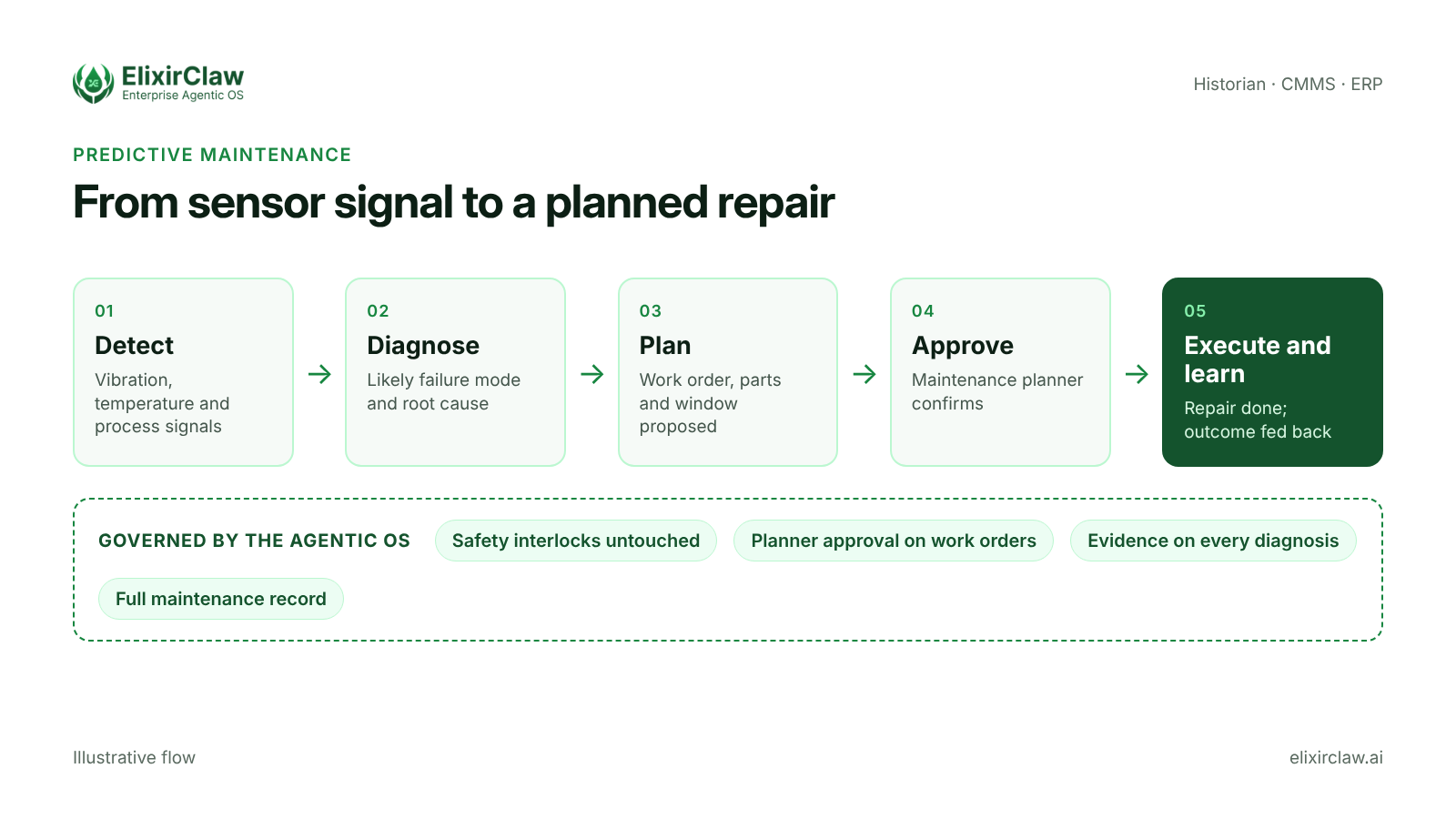
- Detect. The agent watches signals and condition monitoring outputs for patterns that precede failure.
- Diagnose. It compares the pattern with failure modes, past work orders and process conditions to suggest the likely cause, with evidence.
- Plan. It drafts the work order, checks spares and proposes a maintenance window that minimises production impact.
- Approve. The maintenance planner confirms, edits or rejects the plan.
- Execute and learn. After the repair, the technician's findings are recorded and used to improve future diagnoses.
What does this look like in practice?
Take an induced draught fan in a cement plant, a critical asset that stops the kiln if it fails. The agent notices vibration at the non-drive-end bearing rising slowly over ten days, while temperature and fan speed are normal. It compares the pattern with previous work orders and finds a similar trend two years earlier that ended in a bearing replacement. It also notes that dust build-up on the impeller has caused imbalance in the past. The agent drafts a work order to inspect and clean the impeller and check the bearing, confirms a spare bearing is in stock and proposes doing the work during the planned kiln stop in six days. The planner approves. The technicians find dust build-up and early bearing wear, clean the impeller and replace the bearing. Their findings go back into the record, and the next similar pattern will be diagnosed faster.
Which assets suit agentic predictive maintenance first?
- Rotating equipment such as fans, pumps, motors and compressors, where vibration data is rich.
- Critical bottleneck assets whose failure stops a line or a kiln.
- Assets with good maintenance history, so the agent can learn from past work orders.
- Utilities such as compressed air and cooling systems, where failures are costly and often noticed late.
See how this fits with ElixirClaw for asset management and the ElixirClaw blueprint for SAP, which covers plant maintenance integration.
What controls keep maintenance agents safe?
- No changes to safety systems. Agents read from control systems but never alter interlocks, trips or safety instrumented functions.
- Planner approval on work orders and on any change to the production plan.
- Evidence for every diagnosis, so technicians can see why a task was raised.
- A complete maintenance record, linking signal, diagnosis, decision and outcome.
- Machinery compliance. In the EU, the Machinery Regulation (EU) 2023/1230 applies from 20 January 2027 and adds requirements for safety-related software and cybersecurity, which reinforces keeping agents out of the safety layer.
These controls are configured in ElixirClaw's responsible AI controls.
What should a plant measure?
- Unplanned downtime on the target assets.
- Share of maintenance work that is planned rather than reactive.
- Time from first signal to completed repair.
- Diagnosis accuracy, judged by technicians' findings.
- Spares availability for predicted repairs.
What are the risks?
- False alarms erode trust quickly. Start with assets where signals are clear and tune with technicians.
- Poor maintenance history limits learning. Improve work order closure notes as part of the programme.
- Sensor gaps leave blind spots. Add instrumentation where the business case is strongest.
- Cyber exposure from new connections to operational technology. Use read-only, segmented access.
How will predictive maintenance change over the next three to five years?
Expect maintenance to become prescriptive and coordinated: agents will not only predict failures but schedule repairs across assets, spares and crews, aligned with the production plan. Edge processing will bring more diagnosis closer to machines, and digital twins will let agents test the impact of deferring a repair. Regulation is pushing in parallel towards stronger software safety and cybersecurity for machinery, so plants that keep agents in an advisory, well-logged role will be well placed.
How do you start?
- Pick one asset class with a known failure cost and available data.
- Connect the historian and CMMS with read access and agree the approval path.
- Run detection and diagnosis alongside your reliability engineers for a defined period.
- Add work order preparation and scheduling once diagnoses are trusted.
Related reading: shop-floor AI agents for manufacturing operations and digital twins and AI agents.
From alert to planned repair, automatically.
Bring one critical asset to an architecture review. We map the data, the maintenance workflow and the approvals, and you leave with a governed design.
Frequently asked questions
What is predictive maintenance with AI agents?
It is the use of agents to detect early signs of equipment failure, diagnose the cause, prepare the work order and schedule the repair, with a maintenance planner approving the plan.
How is it different from preventive maintenance?
Preventive maintenance follows fixed intervals. Predictive maintenance acts on the actual condition of the equipment, so repairs happen when they are needed.
Do maintenance agents control machines?
No. They read data and prepare work. They do not change control or safety systems, and work orders are approved by planners.
What data is needed?
Sensor and process data from the historian, maintenance history from the CMMS, spares data from ERP and the production plan.
Which assets should we start with?
Critical rotating equipment with good data and a clear cost of failure, such as fans, pumps and compressors on bottleneck lines.


