AI agents for banking compliance monitor customers, transactions and regulatory changes continuously, triage the alerts that result, assemble the evidence an analyst needs and keep a complete record of every step. They do not file reports or close cases on their own judgement in high-stakes areas. Instead they remove the repetitive collection, matching and documentation work that consumes most of a compliance team's day, so qualified people make the decisions faster and with better evidence.
This guide is for chief compliance officers, MLROs and operations leaders in banks and financial institutions. It covers where agents help across KYC, AML and regulatory reporting, what supervisors will expect from AI in compliance and how to start with one process.
Why is compliance work hard to scale?
Compliance teams face rising volumes, more rules and higher expectations of evidence at the same time. Alert queues in transaction monitoring are dominated by false positives. Periodic KYC reviews arrive in waves. Regulatory change has to be traced from a new rule to the policies, controls and systems it affects. Each of these is document-heavy and repetitive, and each needs a clear audit trail.
The supervisory bar is also rising. In the EU, the new Anti-Money Laundering Authority is preparing to directly supervise selected high-risk financial institutions from 2028, with a common rulebook behind it. Banks that can show consistent, well-evidenced decisions will be better placed than those relying on manual effort.
Where do AI agents help across the compliance lifecycle?
| Area | What the agent does | What stays with people |
|---|---|---|
| Customer onboarding (KYC) | Collects and checks documents, screens names, flags gaps and inconsistencies | Risk rating sign-off, enhanced due diligence decisions |
| Periodic and event-driven reviews | Refreshes customer data, compares with prior profile, drafts the review | Approval of the review and any exit decision |
| Transaction monitoring (AML) | Groups related alerts, closes clear false positives with reasons, builds evidence packs | Investigation outcome and suspicious activity reporting |
| Sanctions screening | Resolves obvious false matches using secondary identifiers | True match decisions and escalations |
| Regulatory change | Reads new rules, maps them to policies and controls, drafts impact notes | Interpretation and policy changes |
| Control testing and reporting | Collects evidence, tests controls continuously, flags drift | Attestation and remediation ownership |
How does a compliance agent work day to day?
On ElixirClaw, agents work inside your existing tools and every action is logged.
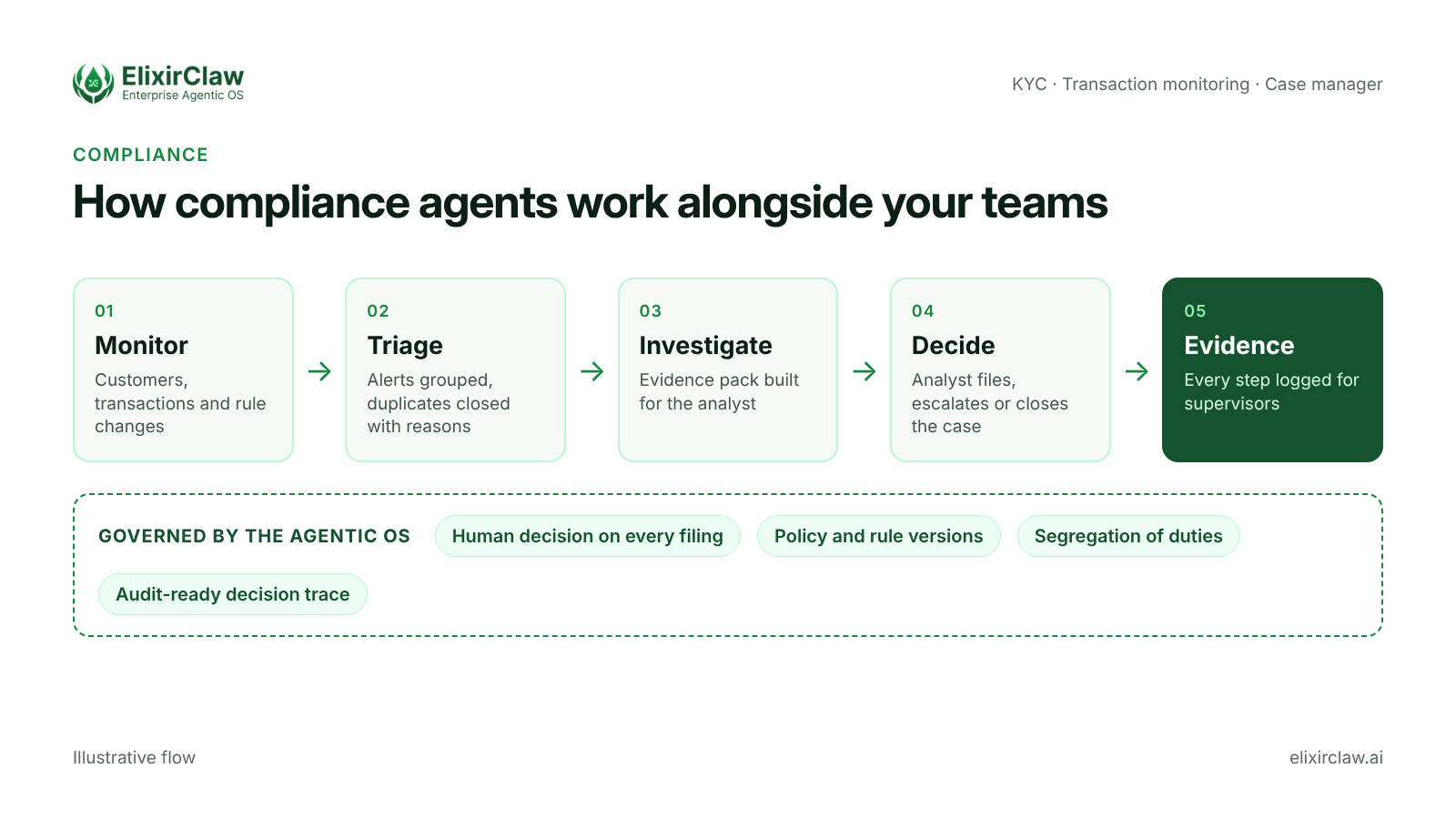
- Monitor. Agents watch customer records, transaction alerts, screening hits and regulatory sources.
- Triage. Related alerts are grouped and duplicates closed, each with a recorded reason a reviewer can check.
- Investigate. For the rest, the agent builds an evidence pack: customer profile, transaction history, counterparties, adverse media and prior cases.
- Decide. An analyst reviews the pack and decides to close, escalate or file. The agent drafts the narrative for the analyst to edit.
- Evidence. The decision trace links inputs, rules, model versions, reviewer and outcome for supervisors and internal audit.
What controls should apply to AI in compliance?
Compliance is the function that has to defend every decision, so the controls on its agents should be stricter than anywhere else.
- Human decision on regulated outcomes. Suspicious activity reports, exits and enhanced due diligence outcomes stay with qualified people.
- Explainable closures. Any alert an agent closes must carry reasons and evidence that a second-line reviewer can sample.
- Versioned rules and models. Every decision records which scenario, threshold and model version applied.
- Segregation of duties. The agent that prepares a case cannot approve it, and access is scoped per agent.
- Quality assurance sampling. A fixed share of agent closures is reviewed every period, with the results fed back into limits.
Our article on AI agent compliance under the EU AI Act, ISO 42001 and NIST AI RMF explains how to produce this evidence for auditors.
How do you measure the impact?
- Alert handling time from creation to decision.
- Share of alerts closed with recorded reasons and the QA pass rate on those closures.
- Backlog of reviews and investigations against service levels.
- Quality of filings, judged by internal review and feedback.
- Time to assess a regulatory change and map it to controls.
How should a bank start?
- Choose one process with a measurable backlog, such as transaction monitoring alert triage or periodic KYC refresh.
- Agree the autonomy level with the MLRO: start with preparation and drafting only.
- Connect the case manager, customer data and screening tools, with read access first.
- Run in parallel with the current team, sample every closure and raise autonomy only on evidence.
The AgentGRC digital worker and the risk and compliance solution show how this runs in practice. Related reading: AI agents for fraud detection.
What are the risks of AI agents in compliance?
- Silent misses. An agent that closes alerts too aggressively can hide real cases. Quality assurance sampling and below-threshold testing catch this early.
- Weak narratives. Draft reports must be reviewed and owned by the analyst; a well-written draft is not a substitute for investigation.
- Stale rules. When regulations or typologies change, scenarios and agent instructions must be updated together and versioned.
- Data protection. Compliance data is highly sensitive. Keep it in your environment, restrict each agent's access and log every read.
How will banking compliance change over the next three to five years?
Supervision is becoming more data-led and more harmonised, with the EU's new AML framework and authority a clear example. Compliance teams will be expected to show consistent decisions at scale and to evidence how they reached them. That will push banks towards continuous monitoring, event-driven KYC instead of fixed review cycles, and control testing that runs every day rather than every quarter. Agents are the practical way to deliver this without growing headcount in line with volumes, provided accountability for regulated decisions stays clearly with people.
Clear the backlog without lowering the bar.
Bring one compliance process to an architecture review. We design the agent, its limits and the evidence your MLRO and auditors will expect.
Frequently asked questions
Can AI agents file suspicious activity reports?
They should not decide to file. Agents can gather evidence and draft the narrative, but the decision and submission stay with a qualified person such as the MLRO or an authorised analyst.
How do AI agents reduce AML false positives?
They group related alerts, check secondary data such as identifiers and transaction context, and close clear false positives with recorded reasons that are sampled by quality assurance.
Are compliance agents acceptable to regulators?
Supervisors focus on outcomes and evidence. Agents that keep people accountable for regulated decisions and record every step make that evidence easier to provide.
Which compliance process should we automate first?
Start where volume is high and decisions are well defined, such as transaction monitoring triage, sanctions false match resolution or periodic KYC refresh.
Do we need to replace our KYC or AML systems?
No. Agents work with your existing screening, monitoring and case management tools through the access you grant them.