In brief
- AI agents raise one audit question again and again: who allowed this action, under which rule, and can you prove it? The EU AI Act, ISO/IEC 42001 and the NIST AI RMF ask it in different words.
- For high-risk uses under Annex III of the EU AI Act, such as employment and credit decisions, obligations now apply from 2 December 2027. That date moved; the requirements for human oversight, logging and log retention did not.
- A governance platform does not make you compliant. What it can do is produce the evidence each framework expects, as a by-product of every agent action rather than as a project before each audit.
- Use the evidence map below to see which artefacts an auditor will ask for, and which of them a Governed Runtime produces automatically.
Why is AI agent compliance different from model compliance?
Because agents act. The evidence you need is about decisions and actions, not only about the model.
Most AI compliance work so far has focused on models: training data, accuracy, bias, documentation. That still matters. But an agent that updates a record, approves a refund or changes access in a production system creates a second kind of risk. The question is no longer only "was the model fit for purpose?" It is "was this specific action allowed, by whom, and is there a record?"
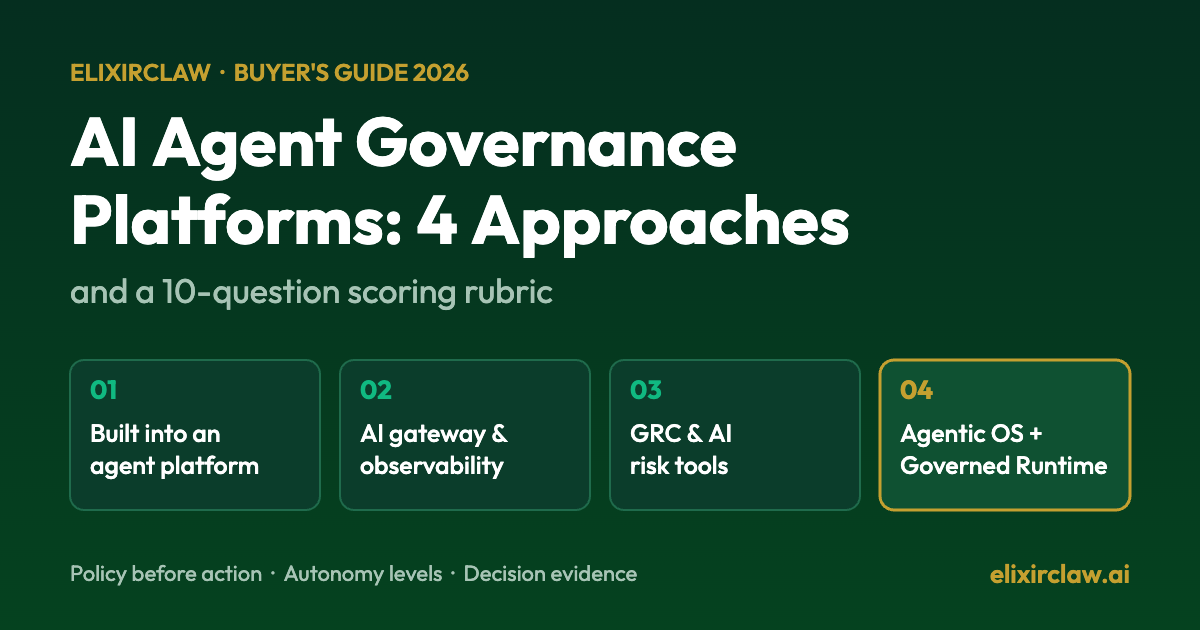
That is the gap the earlier guide, AI Agent Governance Platforms in 2026: 4 Approaches Compared, set out from a buyer's point of view. This post looks at the same gap from the auditor's side: what each framework asks for, and what evidence answers it.
What does the EU AI Act require for AI agents?
It depends on the use, not on the fact that it is an agent. If the use is high-risk, four articles set most of the evidence you will need.
The EU AI Act regulates AI systems by risk. An agent that drafts internal summaries is unlikely to be high-risk. An agent that ranks job candidates, assesses creditworthiness or acts on critical infrastructure may well be, because those uses sit in Annex III. Classification is a legal decision for each use case, and it is the first thing to settle with counsel.
The timetable changed this year. The Digital Omnibus on AI entered into force on 27 July 2026; obligations for stand-alone Annex III high-risk systems now apply from 2 December 2027, and for high-risk AI embedded in regulated products from 2 August 2028. What the obligations say is unchanged.
For a high-risk use, these articles drive most of the evidence:
- Article 12, record-keeping. High-risk systems must automatically record events over their lifetime, so that their operation is traceable, risks can be identified and deployers can monitor them.
- Article 14, human oversight. The people overseeing the system must be able to understand its limits, interpret its output, override or reverse it, and intervene or stop it through a stop control or similar procedure that brings it to a safe state.
- Article 26, deployer obligations. Deployers must use the system according to its instructions, assign competent human oversight, monitor operation, and keep the logs for at least six months, and inform providers and authorities of risks or incidents.
- Article 9, risk management. Providers must run a risk-management system across the lifecycle. If you build your own agents for a high-risk use, you may be the provider as well as the deployer.
Our view: Article 14 is where agents are most exposed. "Override or reverse" and "intervene or stop" are easy to promise for a chatbot and hard to show for an agent that has already written to five systems. Oversight has to happen before the action, not only after it.
What does ISO/IEC 42001 expect?
A management system: policies, roles, risk and impact assessment, and evidence that controls actually operate.
ISO/IEC 42001:2023, published in December 2023, is the first certifiable management-system standard for AI. Like ISO/IEC 27001, it has management-system clauses (4 to 10) and a control catalogue in Annex A, which lists 38 controls under nine control objectives, A.2 to A.10.
Agents put pressure on three parts of it:
- Inventory and scope. You cannot manage AI systems you have not listed. Agents bought inside SaaS products are the ones most often missing from the register.
- Roles and responsibilities. Every agent needs a named owner, and every consequential action a named approver.
- Operation and performance evaluation. Clauses 8 and 9 expect evidence that controls run as designed. For agents, that evidence is the record of each action and the policy that applied to it.
What does the NIST AI RMF ask for?
Four functions applied continuously. For agents, Manage and Measure are where runtime evidence counts.
The NIST AI Risk Management Framework 1.0 (NIST AI 100-1) was published on 26 January 2023 and organises AI risk work into Govern, Map, Measure and Manage. It is voluntary. Its companion Generative AI Profile, NIST AI 600-1, published in July 2024, maps suggested actions for risks that are specific to generative AI back to the same four functions.
- Govern: policies, accountability and an inventory, which overlap heavily with ISO/IEC 42001.
- Map: the context of each use, including who is affected and what can go wrong.
- Measure: testing and monitoring. Execution traces and evaluation results are the evidence.
- Manage: acting on risk, including stopping or rolling back. For agents, that means enforcement at the moment of action.
Which evidence do auditors ask for, and where does it come from?
One evidence set can answer all three frameworks if it is produced at the point of action.
| What the auditor asks | Where it comes from | Evidence a Governed Runtime produces |
|---|---|---|
| Which AI agents do you run, and who owns each one? | ISO/IEC 42001 scope and Annex A; NIST Govern | An agent inventory with owner, autonomy level and connected systems |
| Can you show what this agent did, step by step? | EU AI Act Article 12; NIST Measure | An execution trace: inputs, tool calls, policy result and outcome for each action |
| Who allowed this action, and under which rule? | EU AI Act Articles 14 and 26; ISO/IEC 42001 roles | The policy that was evaluated, the autonomy level applied and the named approver for consequential actions |
| Could a person have stopped it? | EU AI Act Article 14; NIST Manage | Approval steps before execution, plus records of actions that were blocked or modified |
| How long do you keep the records? | EU AI Act Article 26 (at least six months for logs under the deployer's control) | Trace retention set to your policy, in your own environment |
| How do you know the controls work? | ISO/IEC 42001 clauses 8 and 9; NIST Measure | Governance dashboard views of policy hits, approvals and blocked actions over time |
The point of the table is not that one tool satisfies three frameworks. It is that the same records, captured once at the moment of action, can be read by an EU AI Act assessor, an ISO/IEC 42001 auditor and a NIST-based risk team. That is cheaper and more credible than rebuilding evidence before each review.
Where does ElixirClaw fit?
ElixirClaw is an Agentic OS for governed enterprise execution. Its job here is to make the evidence a by-product of how agents run.
- Governed Runtime. Every agent action is checked against policy, authorised and logged before it reaches an enterprise system. The Governed Runtime explainer covers the pipeline in detail.
- Autonomy levels. L1 Read, L2 Suggest, L3 Execute within guardrails and L4 Autonomous within approved boundaries, set per agent, with human approval on consequential actions. This is how oversight happens before the action, which is what Article 14 needs.
- Audit trails and execution traces. A record of what each agent did and why, viewed through the governance dashboard.
- Your agents and vendors' agents. The runtime governs agents whether you built them or bought them, which closes the inventory gap.
- Digital Workers for the compliance team. Agent GRC supports governance, risk and compliance work, and the risk and compliance management solution shows how it fits together.
What ElixirClaw does not do is decide whether your use case is high-risk, or certify you. ElixirClaw produces audit evidence that supports the EU AI Act, ISO/IEC 42001 and the NIST AI RMF; your legal, risk and audit teams decide whether your programme meets them. For the full architecture behind this evidence, see How to Build an Enterprise-Scale Agentic AI Operating System.
What should you do in the next 90 days?
- Classify your agent uses. List every agent, including those inside SaaS products, and ask counsel which uses could fall under Annex III. Start with HR, credit and critical operations.
- Pick one high-risk candidate and write its oversight design. Define the autonomy level, the actions that need approval, the named approver and the stop procedure.
- Produce one complete evidence pack. For a single action, export the trace, the policy result and the approval. If you cannot, that is your gap.
- Set retention to your policy. At least six months for logs under your control if the use is high-risk, longer where sector rules apply.
- Run a mock audit. Ask internal audit to answer the six questions in the table from the evidence alone.
Frequently asked questions
Q: Is every AI agent high-risk under the EU AI Act?
A: No. Risk depends on the use. Agents used for purposes listed in Annex III, such as employment or credit decisions, may be high-risk; many internal productivity uses are not. Classification is a legal decision for each use case.
Q: When do the EU AI Act high-risk obligations apply?
A: After the Digital Omnibus on AI, obligations for stand-alone high-risk systems under Annex III apply from 2 December 2027, and for high-risk AI embedded in regulated products from 2 August 2028.
Q: How long must AI agent logs be kept under the EU AI Act?
A: For high-risk systems, Article 26 requires deployers to keep the automatically generated logs under their control for at least six months, unless other Union or national law says otherwise.
Q: Does ISO/IEC 42001 certification cover AI agents?
A: ISO/IEC 42001 certifies an organisation's AI management system, not a product. Agents fall within its scope when they are part of the AI systems the organisation manages, so they need to be in the inventory and under its controls.
Q: Can one governance platform make us compliant with all three frameworks?
A: No platform makes an organisation compliant. A platform can produce audit evidence that supports all three; whether the programme meets them is decided by your legal, risk and audit teams.
See the evidence pack for one of your workflows
Bring one agent use case. We will show the trace, the policy result and the approval record the Governed Runtime produces for it.