Autonomous customer engagement means AI agents that resolve customer requests from start to finish, not just answer questions. In retail, agents can track orders, change deliveries, process returns, issue refunds within limits and resolve product questions across chat, email, voice and messaging, then hand complex or sensitive cases to a person with the full context. Customers get answers in minutes at any hour; service teams spend their time on the conversations that need human judgement.
This guide is for customer, digital and operations leaders in retail. It explains what autonomous engagement covers, where it pays back, the rules and controls it needs and how to start.
Why is customer engagement moving from chatbots to agents?
Earlier chatbots could answer frequently asked questions but rarely completed a task, so customers often ended up repeating themselves to a person. Agents connect to order, payment and customer systems, so they can act. Gartner predicts that by 2029 agentic AI will autonomously resolve 80% of common customer service issues without human intervention, leading to a 30% reduction in operational costs.
What can engagement agents handle?
| Request | Agent action | When a person steps in |
|---|---|---|
| Where is my order? | Tracks shipment, explains delays, offers options | Lost parcel above a value limit |
| Change delivery | Updates address or slot where allowed | Suspected fraud or account takeover |
| Return or exchange | Checks policy, creates the return, books collection | Outside policy or disputed condition |
| Refund | Issues refund within agreed limits | Above limit or repeat claims |
| Product question | Answers from product data and stock | Safety or specialist advice |
| Complaint | Acknowledges, gathers facts, offers goodwill within limits | Vulnerable customers or escalations |
How does the engagement loop work?
On ElixirClaw, engagement agents connect commerce, order management, CRM and contact centre systems.
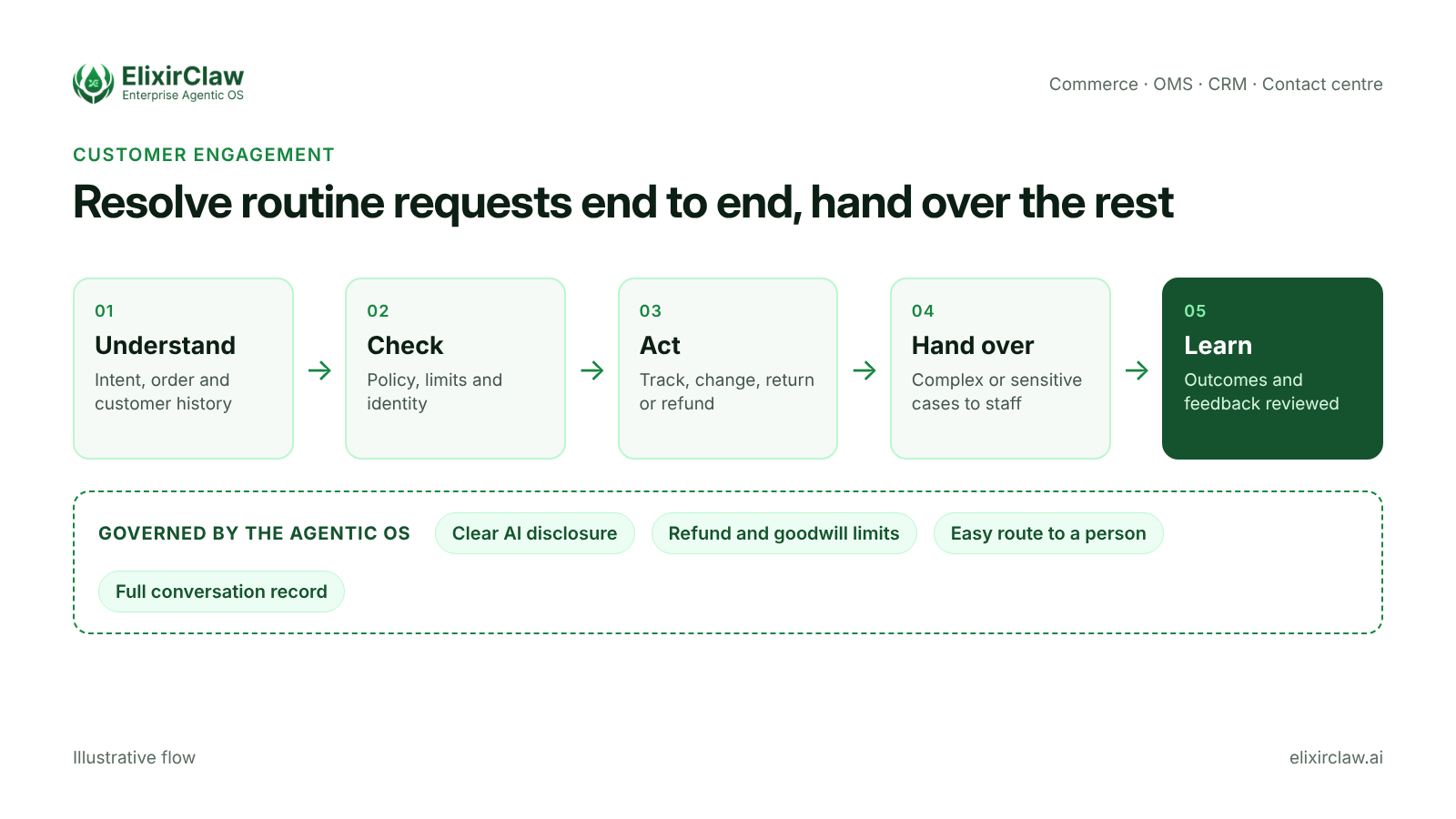
- Understand. The agent identifies intent and reads the customer's orders and history.
- Check. It verifies identity and checks policy, limits and risk signals.
- Act. It completes the task in the right system and confirms with the customer.
- Hand over. Complex, high-value or sensitive cases go to staff with a summary of the conversation.
- Learn. Outcomes, satisfaction and handovers are reviewed to improve policies and answers.
What does this look like in practice?
A customer messages a fashion retailer late on a Sunday: her jacket arrived in the wrong size and she needs the right one for a wedding on Friday. The agent finds the order, confirms the exchange is within policy and checks stock: the right size is out of stock online but available in a store near her. It offers two options: an exchange shipped from the warehouse when restocked on Wednesday, or a reservation for collection in store tomorrow with a free return label for the wrong size. She chooses the store. The agent reserves the jacket, creates the return and sends the details. No person was needed. A second customer the same evening mentions that a product caused an allergic reaction; the agent immediately hands that conversation to the duty team with the full history, as policy requires.
What rules apply to AI customer engagement?
- Disclosure. Under Article 50 of the EU AI Act, which applies from 2 August 2026, people must be told when they are interacting with an AI system, unless it is obvious.
- Consumer protection. Answers about prices, returns and rights must be accurate. Retailers remain responsible for what their agents say.
- Data protection. Identity checks, data minimisation and records of processing apply as they do for human agents.
- Vulnerable customers need a clear, easy route to a person.
What controls should be in place?
- Refund, goodwill and value limits agents cannot exceed.
- Answers grounded in approved policies and product data, not general knowledge.
- Clear handover triggers for safety, fraud, complaints and vulnerability.
- A full record of every conversation and action.
- Quality review of samples by the service team.
These are configured in ElixirClaw's responsible AI controls.
What should you measure?
- Share of requests resolved without a person.
- Customer satisfaction and repeat contacts.
- Time to resolution.
- Refund and goodwill cost against policy.
- Quality of handovers to staff.
What are the risks?
- Wrong answers about policy or rights. Ground answers in approved sources and test them.
- Refund abuse. Use limits and risk signals, and watch for patterns.
- Customers trapped with a bot. Always offer a route to a person.
- Brand voice drift. Review samples and tune tone regularly.
How will customer engagement change over the next three to five years?
Most routine retail service will be handled end to end by agents, and the contact centre will become a team of specialists handling complex and emotional cases. Engagement will also become proactive: agents will contact customers about a delay or a recall before they ask. A growing share of requests will come from customers' own AI assistants, so retailers will need agents that can deal reliably and securely with other agents. Retailers that keep strong human routes for complex needs will earn the most trust.
How do you start?
- Pick two or three high-volume requests, such as order tracking and returns.
- Connect order and customer systems, and agree limits and handover rules.
- Launch in one channel with clear AI disclosure and quality review.
- Measure resolution, satisfaction and cost before adding more requests and channels.
Related reading: AI agents for retail contact centres, AI agents for hyper-personalisation and ElixirClaw for retail.
Resolve routine requests in minutes, at any hour.
Bring your top customer requests to an architecture review. We map the systems, limits and handovers, and you leave with a governed design.
Frequently asked questions
What is autonomous customer engagement?
It is AI agents resolving customer requests from start to finish, such as returns and delivery changes, and handing complex cases to people.
How is an AI agent different from a chatbot?
A chatbot answers questions; an agent connects to order and customer systems and completes tasks within policy and limits.
Do customers have to be told they are talking to AI?
In the EU, Article 50 of the AI Act requires people to be told when they interact with an AI system unless it is obvious. It applies from 2 August 2026.
Can AI agents issue refunds?
Yes, within limits the retailer sets. Refunds above the limit, or with risk signals, go to a person.
Where should a retailer start?
With two or three high-volume requests in one channel, with clear limits, handover rules and quality review.