AI agents for retail store operations turn the signals a store already produces into a short, ranked list of the tasks that matter most. They combine shelf and stock data, point of sale, price files, deliveries and footfall to spot empty shelves, wrong prices and queues, rank tasks by sales impact, send them to the right team member once the store manager agrees, and check that they were done. Store teams spend less time searching for problems and more time fixing them and serving customers.
This guide is for store operations, retail operations and COO teams. It explains what AI store operations covers, how to deploy it in a privacy-safe way, the controls it needs and how to start.
Why are store operations so hard to run well?
Stores lose sales every day to problems nobody notices in time: a gap on a shelf, a wrong price label, a delivery left in the back room, a queue that builds at the wrong hour. IHL Group estimated in 2025 that out-of-stocks and overstocks together cost retailers about $1.73 trillion a year. Store managers juggle head office tasks, staffing and customers, often with fewer staff than before, and much of their time goes on walking the floor looking for problems.
What do store operations agents do?
| Area | Agent support | Who decides |
|---|---|---|
| Availability | Spots gaps and phantom stock, creates replenishment tasks | Store manager |
| Pricing | Flags label and system price mismatches after price changes | Store manager |
| Deliveries | Prioritises unloading and putaway by sales impact | Shift lead |
| Staffing | Suggests moving staff to tills or the floor as footfall changes | Store manager |
| Head office tasks | Summarises and schedules planograms, promotions and compliance checks | Store manager |
| Fresh and waste | Suggests markdowns and rotation before products expire | Store manager, within pricing rules |
How does the store loop work?
On ElixirClaw, store agents connect point of sale, inventory, workforce and, where used, shelf camera systems.
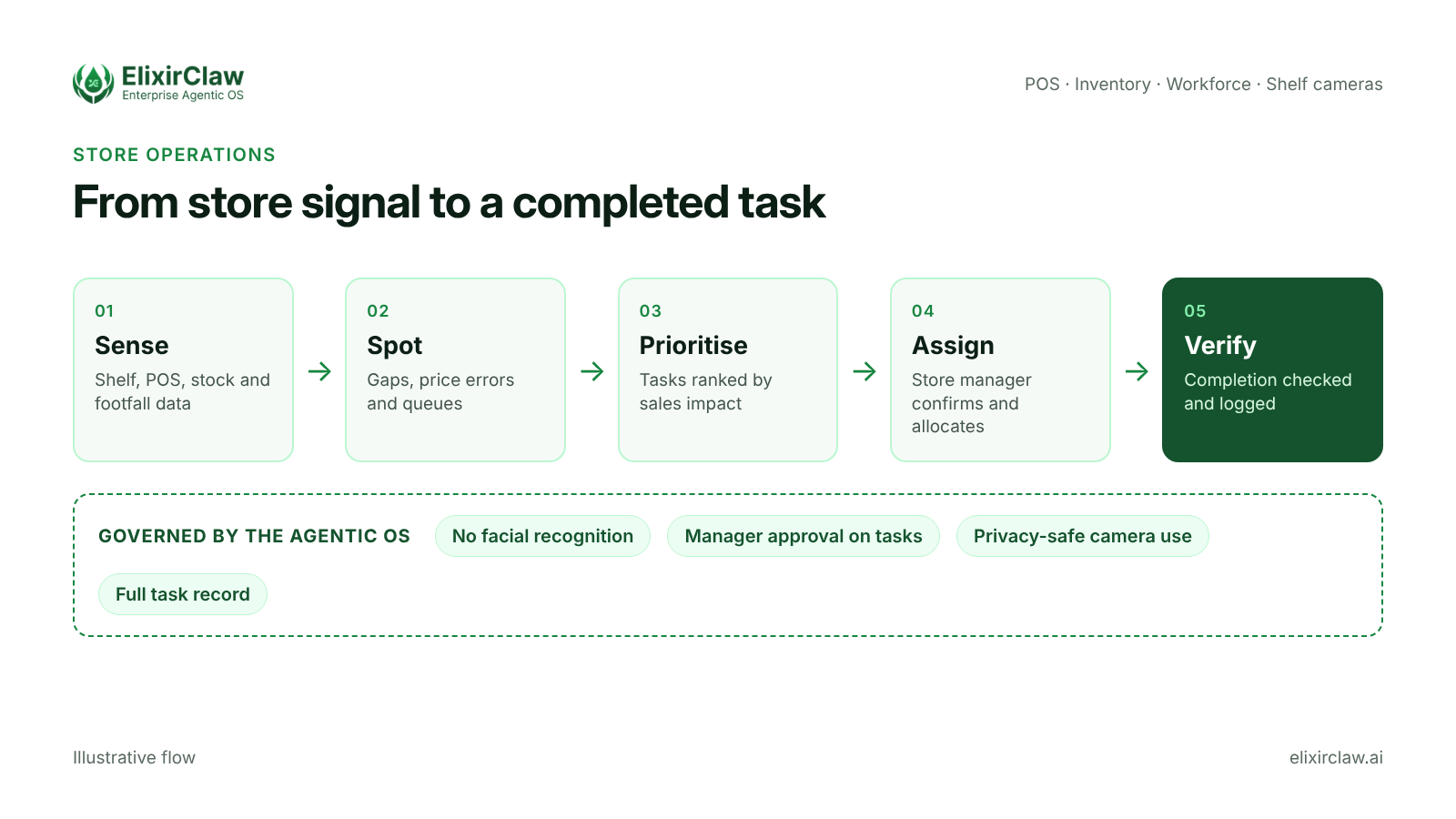
- Sense. Agents read sales, stock, price files, deliveries, footfall and shelf images.
- Spot. They detect gaps, price errors, queues and expiring products.
- Prioritise. Tasks are ranked by sales impact and urgency.
- Assign. The store manager confirms, and tasks go to team members' devices.
- Verify. Completion is checked against data or images and logged.
What does this look like in practice?
At 10 a.m. on a Saturday, a supermarket's sales of a popular yoghurt stop abruptly although the system shows 48 units in stock. The agent compares this with shelf images and finds the shelf empty; the stock is still on a delivery cage in the back room. At the same time, it detects that a price change on coffee went live in the system but not on the shelf labels. It ranks the yoghurt first, because of lost sales, and the coffee labels second, because of the risk of overcharging customers. The store manager approves both, the tasks go to two colleagues' handhelds, and within twenty minutes the agent confirms from new images and sales that the shelf is full and the labels updated. The weekly report shows which delivery steps caused back-room stock, so the regional team can fix the process.
How do you use cameras without harming privacy?
Shelf cameras and computer vision can help, but only if they focus on products, not people. The safest designs analyse shelves, not faces, and blur or discard people in images. Regulators take this seriously: the US Federal Trade Commission banned Rite Aid from using facial recognition for surveillance for five years after finding that its system had falsely flagged customers. In Europe, the GDPR and the AI Act place strict limits on biometric identification. ElixirClaw store agents do not use facial recognition.
What controls do store agents need?
- No facial recognition, and people removed from images used for analysis.
- Manager approval for tasks and staffing changes.
- Pricing changes and markdowns only within head office rules.
- Clear notices to customers and staff about camera use.
- A task record showing what was flagged, decided and completed.
These are configured in ElixirClaw's responsible AI controls.
What should you measure?
- On-shelf availability and lost sales.
- Price accuracy at the shelf.
- Waste and markdowns for fresh products.
- Task completion time.
- Manager time spent walking the floor to find problems.
What are the risks?
- Too many tasks overwhelm teams. Rank by impact and limit the list.
- Inaccurate stock records cause false alerts. Fix phantom stock as you go.
- Privacy concerns from customers and staff. Design for products, not people, and be open about it.
- Staff buy-in. Involve store teams early and use their feedback.
How will store operations change over the next three to five years?
Stores will run on prioritised task lists rather than fixed routines, with agents coordinating replenishment, pricing, staffing and head office tasks in one view. Shelf sensing will become cheaper, and robots will take on more scanning and restocking in larger stores. Store managers will act more as coaches and decision makers, with agents handling the monitoring. Retailers that combine this with strong privacy practices will gain both efficiency and customer trust.
How do you start?
- Pick a small group of stores and one problem, such as availability or price accuracy.
- Connect sales, stock and price data, and add shelf images only if needed.
- Agree task limits and approvals with store managers.
- Measure availability, price accuracy and task time before extending.
Related reading: shelf space optimisation with AI agents, AI agents for demand forecasting and ElixirClaw for retail.
Fix the problems that cost sales, store by store.
Bring one store problem to an architecture review. We map the data, the tasks and the approvals, and you leave with a governed design.
Frequently asked questions
What are AI store operations?
They use AI to detect store problems such as empty shelves, wrong prices and queues, rank tasks by impact and track them to completion.
Do AI store agents use facial recognition?
ElixirClaw store agents do not. Shelf images are used to analyse products, and people are removed from images.
Can agents change prices in store?
Agents flag price errors and suggest markdowns within head office pricing rules; store managers approve the actions.
Do we need shelf cameras?
No. Many problems can be found from sales and stock data alone. Cameras add accuracy where availability matters most.
Where should a retailer start?
With a small group of stores and one problem, such as availability or price accuracy, agreed with store managers.