Executive Summary
Enterprises often face challenges in retrieving accurate and unified information across disparate data systems. Agent Search addresses this by combining AWS-native services such as Amazon EKS, Bedrock, Neptune, OpenSearch, and RDS to deliver semantic search capabilities over both structured and unstructured data. Built on GraphRAG architecture, the platform leverages LLM-powered reasoning with real-time context retrieval from graph and vector stores. This case study outlines how Agent Search helped customers unify access to knowledge silos, enhancing productivity, compliance, and decision-making across departments.
Customer Challenge
Customer Information
-
Customer: Confidential (Representative of BFSI, Healthcare, and E-commerce sectors)
-
Industry: Multi-industry (BFSI, Healthcare, E-commerce)
-
Location: Global operations
-
Company Size: 1,000+ employees
Business Challenges
-
Data scattered across relational databases, search indexes, object storage, and knowledge graphs created a fragmented experience for business analysts and compliance teams.
-
Existing tools offered only keyword-based search with no semantic understanding, limiting their effectiveness for legal, policy, and customer insights.
-
Stakeholders lacked traceable, accurate answers to business-critical questions.
-
Regulatory requirements demanded precise documentation access with traceability.
-
There was increasing pressure to enable real-time policy discovery, especially in fast-changing compliance environments.
Technical Challenges
-
Integrating and indexing data from multiple sources: S3, RDS, Neptune, and OpenSearch.
-
Ensuring secure IAM-based access while maintaining auditability and compliance.
-
Enabling performant semantic search at scale with scalable, containerized infrastructure.
-
Operationalizing GraphRAG on Kubernetes while managing LLM interactions through Bedrock.
-
Aligning with AWS security and VPC policies for enterprise compliance.
Partner Solution
Solution Overview
Agent Search delivers an intelligent, LLM-powered, real-time semantic search platform built on Kubernetes and AWS-native services. The platform enables cross-silo search by integrating graph databases (Neptune), vector stores (OpenSearch), and relational data (RDS), enhanced through Bedrock LLMs. A modular indexing framework built on Kubernetes jobs handles ingestion, while GraphRAG enables dynamic retrieval-augmented generation (RAG). IAM-secured APIs allow seamless integration across the enterprise.
AWS Services Used
-
Amazon EKS: Hosts the GraphRAG API server and indexing workers.
-
Amazon Bedrock: Provides LLM reasoning capabilities.
-
Amazon Neptune: Stores graph data and metadata context.
-
Amazon OpenSearch: Used as a vector DB for semantic similarity search.
-
Amazon RDS: Stores structured data such as policy tables.
-
Amazon S3: Houses documents and unstructured files.
-
IAM: Controls secure, scoped access to services.
-
CloudWatch: Enables observability and alerting.
-
Amazon ECR: Container image repository for deployment.
Architecture Diagram
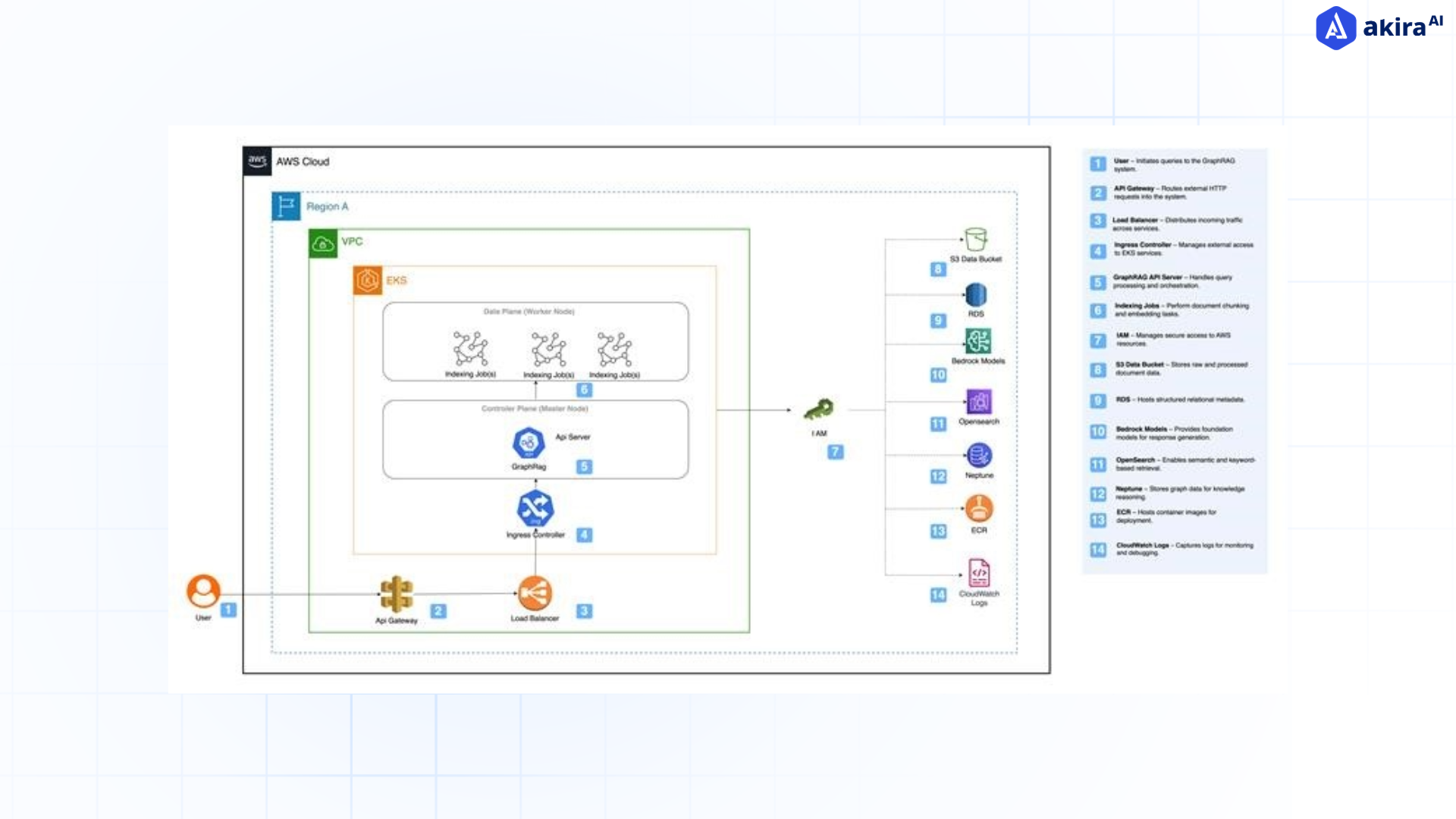
Implementation Details
-
Deployment: Helm-based deployment on Amazon EKS using separate control and data planes.
-
Methodology: Agile delivery with continuous integration and testing pipelines.
-
Security: IAM roles scoped per service with TLS in transit and SSE encryption at rest.
-
Testing: Performed synthetic and real-data search scenarios with trace logging.
-
Timeline: Initial prototype in 2 weeks; production deployment in 6 weeks.
-
Integration: API Gateway enabled access to web UIs and Slack bots.
-
Observability: CloudWatch and custom dashboards ensure transparency in query resolution.
Innovation and Best Practices
-
Used GraphRAG with AWS-native vector and graph stores for real-time contextual augmentation.
-
Employed Kubernetes autoscaling for indexing scalability and latency reduction.
-
Followed AWS Well-Architected Framework: security, reliability, performance efficiency.
-
Integrated CI/CD pipelines to manage iterative improvement cycles and LLM prompt tuning.
-
Introduced reusable Helm charts and IAM templates for faster customer rollout.
Results and Benefits
Business Outcomes and Success Metrics
-
Reduction in Time to Insight: 65% faster discovery of policy and compliance documents.
-
Increased Query Accuracy: 80% improvement in answer relevancy compared to legacy search.
-
Improved Compliance: Enabled traceable document access for audits and regulators.
-
Team Productivity: Reduced analyst research time by ~40% via semantic automation.
-
Cost Efficiency: Eliminated siloed tools, reducing TCO by ~30%.
Technical Benefits
-
Elastic Scalability: EKS-based worker pods scale with query load.
-
Performance: Optimized through async indexing and Bedrock’s LLM streaming.
-
Availability: High availability via multi-zone Kubernetes deployment.
-
Security: Full audit trail with scoped IAM, VPC isolation, and encrypted data layers.
-
Modular Extensibility: New sources and use cases can be added with minimal rework.
Lessons Learned
Challenges Overcome
-
Initial ingestion of large legacy datasets required batch migration jobs and tuning of indexing pods.
-
Managing Bedrock API limits requires implementing retry and fallback strategies.
-
Ensuring consistent context mapping across graph/vector stores requires schema unification.
Best Practices Identified
-
Pre-indexing data during off-peak hours reduces latency under heavy query load.
-
Establish robust observability (CloudWatch + custom traces) for accelerated debugging.
-
Modularizing the agent pipeline helps isolate and tune RAG components independently.
Future Plans
-
Expand deployment to multiple regions and introduce multi-tenant features.
-
Add support for user feedback loops to tune model outputs.
-
Integrate with Microsoft Teams and Confluence for inline search.
-
Explore AWS Marketplace launch and open ecosystem partner integrations.


.png)