AI agents for clinical decision support bring the right information to a clinician at the moment of a decision: they read the relevant parts of the patient record, retrieve the applicable guideline or local pathway, and suggest options with the reasons and sources behind each one. The clinician accepts, changes or dismisses the suggestion, and that choice is recorded. Done well, agentic decision support reduces missed steps and variation in care without adding to alert fatigue, because it is specific to the patient and shows its working.
This guide is for chief medical and clinical information officers, and for digital health leaders choosing how to bring AI into clinical decisions safely. It covers what agentic decision support is, where it helps, how it is regulated in the US and Europe and how to start.
What is clinical decision support, and what do agents add?
Clinical decision support (CDS) is any tool that helps clinicians make better decisions: drug interaction alerts, order sets, risk scores, reminders and guideline prompts. Traditional CDS is rule-based and generic, which is why so many alerts are overridden. Agents add three things:
- Context. They read the whole record, including notes and letters, not only coded fields.
- Evidence. They retrieve the specific guideline, pathway or formulary entry that applies and cite it.
- Follow-through. They can prepare the order, referral or patient information for the clinician to approve, rather than stopping at an alert.
How does an agentic CDS workflow run?
On ElixirClaw, decision support agents work inside the EHR and order entry workflow, with the clinician deciding at every step.
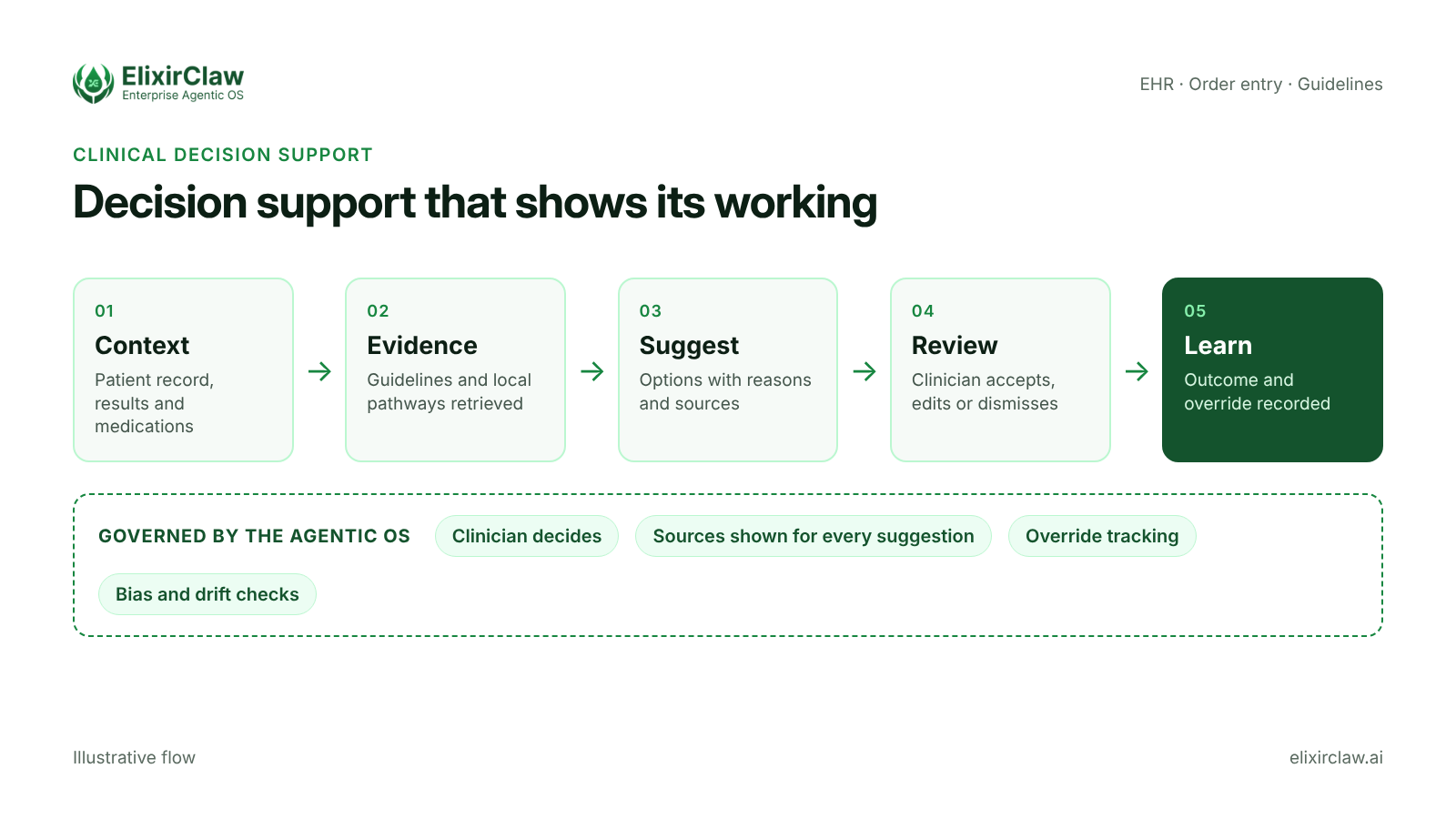
- Context. The agent assembles the relevant problems, results, medications, allergies and recent events.
- Evidence. It retrieves the applicable national guideline, local pathway or formulary rule.
- Suggest. It proposes options, such as a dose adjustment, a test or a referral, with the reasons and sources visible.
- Review. The clinician accepts, edits or dismisses. Nothing is ordered without them.
- Learn. The decision, any override reason and later outcomes are recorded to improve rules and spot problems.
Where does agentic decision support help most?
| Area | Example of agent support |
|---|---|
| Medication safety | Renal dose adjustment using the latest results, with the formulary rule cited |
| Deterioration | Combining observations, results and notes to flag patients for review, with the trend shown |
| Guideline adherence | Checking a sepsis, VTE or cancer pathway step has been completed and preparing the next order |
| Diagnostic support | Listing differentials to consider from symptoms and results, with references |
| Discharge | Checking medicines reconciliation, follow-up and patient information before discharge |
Related reading: AI agents in healthcare diagnostics and our earlier article on AI agents for readmission risk prevention.
How is clinical decision support regulated?
- FDA (United States). The FDA's Clinical Decision Support Software guidance, finalised in September 2022, sets out four criteria. Software that meets all four, including that a clinician can independently review the basis of the recommendation, is not regulated as a device. Software that analyses images or signals, or that gives time-critical directives, generally is.
- ONC (United States). The HTI-1 final rule replaced the old CDS certification criterion with "decision support interventions" and requires certified health IT to give users information about predictive algorithms, so they can judge whether a model is appropriate for their patients.
- European Union. Decision support that qualifies as a medical device falls under the medical device regulations and, through them, the AI Act's high-risk rules. Under the Digital Omnibus adopted in June 2026, those AI Act obligations apply to AI embedded in regulated products from 2 August 2028.
The common thread is transparency: clinicians must be able to see why a suggestion was made. Agents that cite sources and show their reasoning are easier to keep on the right side of these rules.
What safeguards should every CDS agent have?
- The clinician decides. Suggestions are suggestions; orders need a clinician's action.
- Sources on every suggestion. The guideline, rule or result behind it is one click away.
- Override tracking. High override rates show where rules or models need changing.
- Bias and drift checks. Performance is monitored across patient groups and over time.
- Change control. Updates to rules, models and prompts are versioned, tested and signed off by a clinical safety officer.
See how these controls are enforced in ElixirClaw's responsible AI controls.
What does this look like in practice?
A patient admitted with pneumonia has a prescription for an antibiotic that is cleared by the kidneys. Overnight, the creatinine result rises. A traditional rule fires a generic renal alert that is easy to dismiss. An agent instead reads the trend in kidney function, the current dose, the indication in the admission note and the hospital's antimicrobial guideline. It suggests a specific adjusted dose, shows the creatinine trend, cites the guideline section and notes that the patient's weight was recorded on admission. The prescriber opens the suggestion, agrees, and the agent prepares the amended prescription for them to sign. The pharmacist sees the change and the reasoning in their review queue. If the prescriber had dismissed the suggestion, the reason would have been recorded and reviewed by the antimicrobial team.
What are the risks?
- Alert fatigue. More suggestions are not better. Measure acceptance and remove low-value prompts.
- Incorrect or outdated guidance. Retrieval must use current, approved sources, with local pathways taking precedence where they apply.
- Automation bias. Confident suggestions can anchor decisions. Show uncertainty and alternatives.
- Accountability gaps. Clinical safety ownership must be clear for each agent and each rule set.
How will clinical decision support change over the next three to five years?
Decision support will move from isolated alerts to agents that follow a patient's pathway, prepare the next step and close loops such as pending results and follow-ups. Large language models will make it practical to use free-text notes, but regulators will expect clear evidence, version control and monitoring of real-world performance. Organisations that build a library of governed, cited clinical rules now will be able to adopt more capable models without starting their safety case again.
How do you start?
- Choose one high-value, well-defined decision, such as renal dosing or VTE prophylaxis.
- Agree the source guidance and the clinical safety owner.
- Run the agent in suggest-only mode and measure acceptance, overrides and outcomes.
- Extend to the next decision once the safety case and results are signed off.
Learn more about ElixirClaw for healthcare and life sciences.
Decision support clinicians can see through.
Bring one clinical decision to an architecture review. We design the agent, the evidence sources and the safety controls your clinical safety officer will need.
Frequently asked questions
What is AI clinical decision support?
It is software that uses AI to give clinicians patient-specific suggestions at the point of care, such as dosing, tests or referrals, with the reasons and sources shown.
Is AI clinical decision support a medical device?
It depends on what it does. In the US, software that meets all four FDA criteria, including allowing the clinician to independently review the basis of the suggestion, is not regulated as a device. Software that analyses images or gives time-critical directives usually is.
How do AI agents reduce alert fatigue?
By using the full patient context to make suggestions specific, by citing their sources and by tracking overrides so low-value prompts can be removed.
Who is accountable for a decision made with AI support?
The clinician who makes the decision, supported by a clinical safety process that owns the rules and models behind the agent.
Where should a hospital start with agentic CDS?
With one well-defined decision that has clear guidance and measurable outcomes, such as medication dosing or VTE prophylaxis, in suggest-only mode.